Évian-les-Bains hosts Tour de France 2026 stage 16 time trial

The Tour de France 2026 continued with its sole individual time trial on Tuesday, July 21, a 26.1km route from Évian-les-Bains to Thonon-les-Bains. The stage, which featured a significant climb and descent, saw Remco Evenepoel emerge as a strong contender for the stage win, while Paul Seixas and Isaac del Toro are competing for the young rider’s jersey.
The course presented a challenging profile, starting with an immediate climb and including the Côte de Larringes, a 9.7km ascent with an average gradient of 4.3%. Despite starting and finishing at the same altitude near Lake Geneva, riders faced nearly 500m of climbing. The final 9km were flatter, favoring those who could maintain power after the initial ascent.
Evenepoel’s Performance and Other Riders
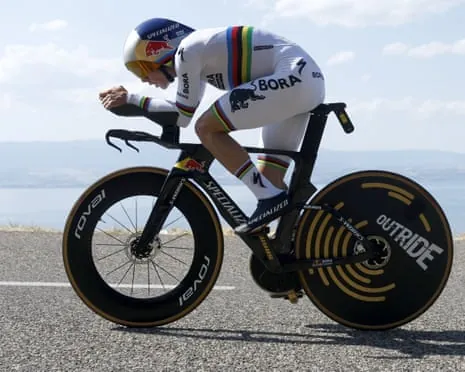
Remco Evenepoel, the reigning time trial world champion, demonstrated strong form throughout the stage. He was notably quicker than competitors at the second time check, surpassing Mattias Skjelmose by 56 seconds and Tadej Pogacar by 14 seconds. Evenepoel’s performance positioned him as a leading candidate for the stage victory.
Early in the stage, Josh Tarling of Netcompany-Ineos set the quickest time at 34 minutes 21 seconds. His teammate, Filippo Ganna, finished just four seconds behind. Other notable times included Mattia Cattaneo, who held a 13-second advantage over Bruno Armirail in the final kilometer, averaging 46km/h across the course. Pablo Castrillo, the Spanish time trial champion, also showed a strong pace at the second checkpoint.
However, the stage also saw a significant incident involving Lipowitz, who crashed after his wheel slid out on a bend. He appeared to have landed hard on his shoulder and possibly hit his head, raising concerns about his continuation in the race.
Thymen Arensman experienced an unfortunate delay at the start gate, which could have impacted his overall time. Meanwhile, Juan Ayuso was reported to be losing substantial time, with his lead over teammate Skjelmose nearly halved.
Equipment and Strategy for the Time Trial
The unique demands of the stage influenced equipment choices for many riders. Tadej Pogacar‘s Colnago TT2, designed specifically for his Tour de France bid, featured a claimed weight reduction of 550g from its predecessor, the TT1. His spare bike weighed 8.14kg, though his main bike with custom carbon extensions was expected to be lighter.
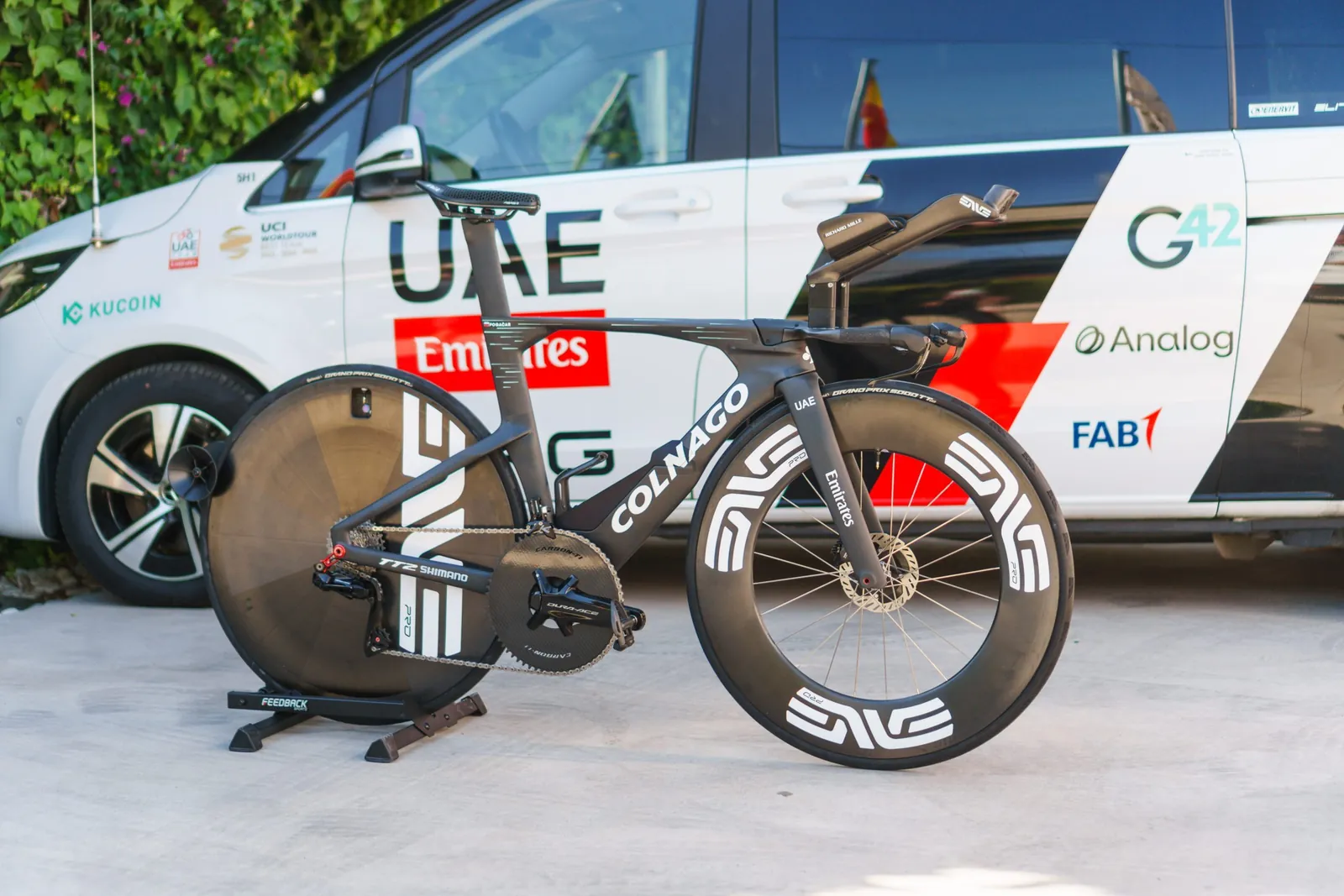
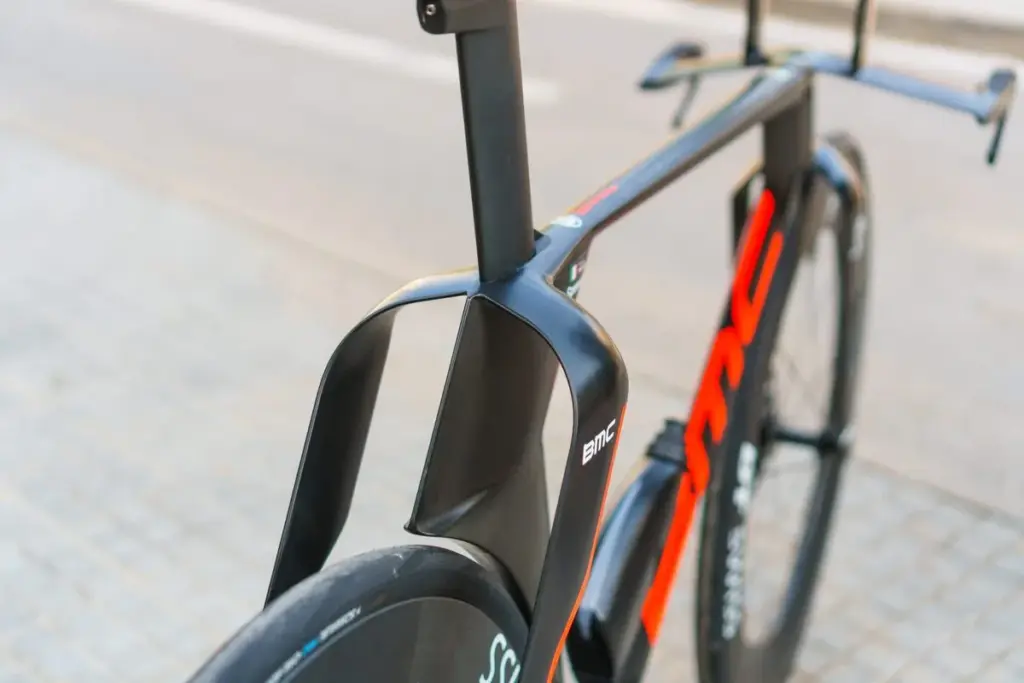
Pogacar‘s setup included a 64-tooth 1x Carbon-Ti chainring and Continental Grand Prix 5000 TT TR 25mm tires on ENVE wheels. Matteo Trentin‘s BMC Timemachine Mpc, inspired by track bikes, featured slim frame tubes and a narrow 350mm base bar. His bike weighed 9.8kg and used SRAM groupsets with a 60T chainring.
Mauro Schmid of Jayco AlUla rode a Giant Trinity Advanced SL, equipped with 28mm Vittoria Corsa Speed tires on Cadex wheels. His bike weighed 9.3kg. Tom Pidcock utilized a Pinarello Bolide F, which incorporates biomimicry in its design, and weighed 8.5kg. Per Strand Hagenes‘ Cervélo P5 featured a bayonet fork and a 68-tooth SRAM aero chainring, the largest observed.
The stage’s profile, with its climb and descent, meant that riders had to balance power output with aerodynamic efficiency. Valentin Paret-Peintre, wearing the polka dot jersey, focused on the climb to secure mountain points, anticipating that general classification leaders might pace themselves more evenly.
The Tour de France will continue with Niall McVeigh on blogging duty for the next stage, and further updates are expected for stage 18 on Thursday.
Read Also
Source: theguardian.com

